
Money, Payment and Currency on Bornholm
Card, cash or euros on Bornholm, which payment works best, where to find cash machines, and the fee traps to watch for as a tourist in 2026.
Contents
The Danish krone
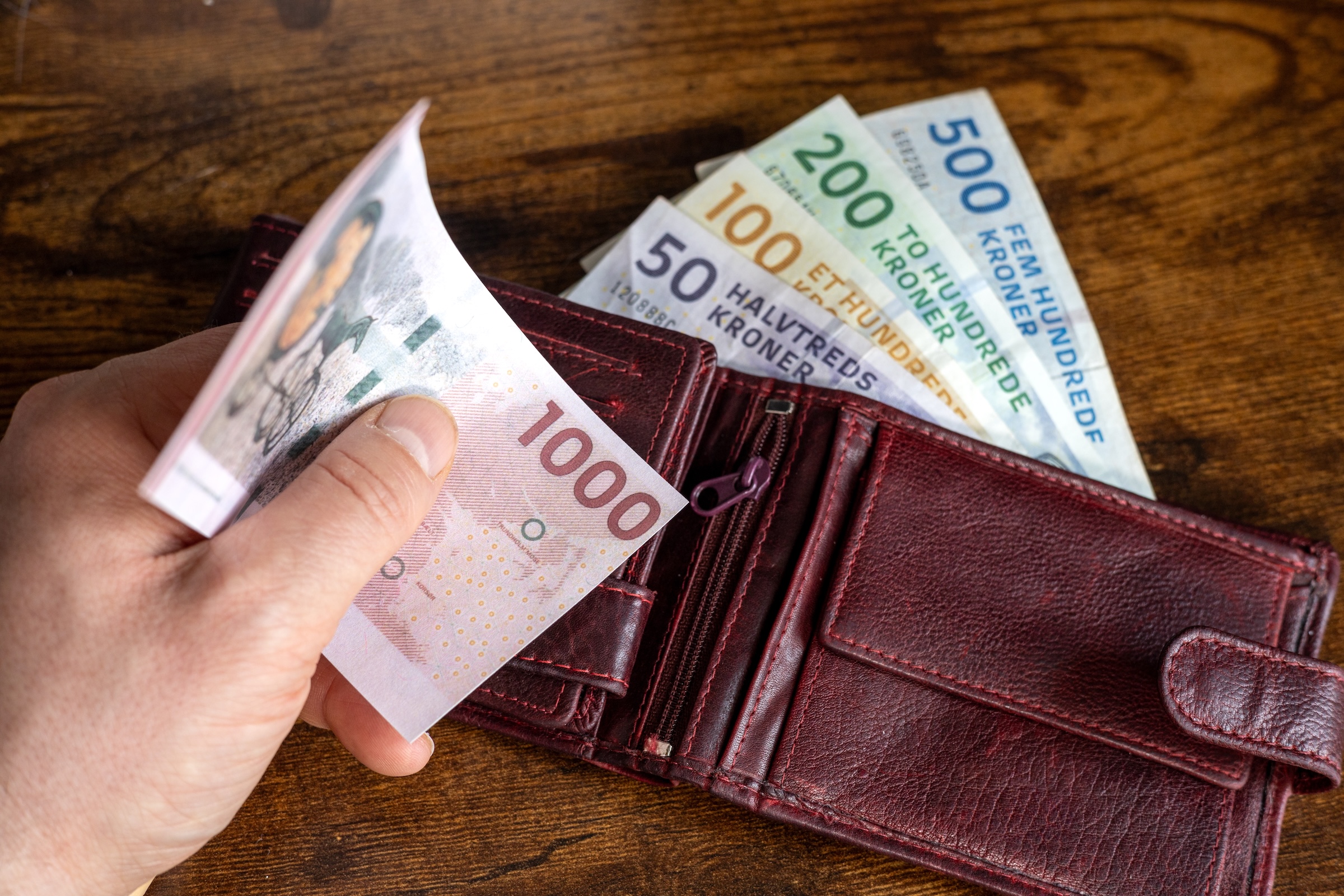
The Danish krone (DKK) has been Denmark's currency since 1875 and is the only legal tender on Bornholm. One krone divides into 100 øre, and the smallest coin in circulation is the 50-øre piece. There are banknotes for 50, 100, 200, 500 and 1,000 kroner, and coins for 50 øre and 1, 2, 5, 10 and 20 kroner. One quirk, the 1-, 2- and 5-krone coins have a hole through the middle.
Handy for visitors is the krone's tight link to the euro, it trades within the ERM II mechanism around a central rate of roughly 7.46 DKK to the euro, within a narrow band. That makes the exchange rate reliably predictable across your trip, and it's still sitting at around 7.46 as of June 2026.
A note on old cash, banknotes that became invalid on 31 May 2025 (all series up to and including 1997, plus the 2009-series 1,000-krone note) could only be exchanged until the end of May 2026, latterly in person at a handful of branches in Copenhagen, Odense and Aarhus. That deadline has now passed, so these notes are worthless today. Older series that remain valid, however, stay valid indefinitely and can be exchanged through a Danish bank. If you've still got Danish leftovers from a previous trip, check the series before you travel.
Paying by card, the Danish standard
Denmark pays by card far more consistently than many visitors are used to, from a hot dog to a takeaway coffee to a flea-market stall, almost everything runs cashless. Visa and Mastercard are accepted almost everywhere, even for tiny amounts. American Express and Diners Club, by contrast, are far from universally accepted. Contactless payment, Apple Pay and Google Pay generally work without a hitch.
Since early 2018, the EU's Payment Services Directive (PSD2) has banned surcharging, when you pay with a consumer Visa or Mastercard in person, Danish merchants aren't allowed to add extra fees to the bill. This ban, along with capped interchange fees, remains unchanged in 2026. The follow-up rules, PSD3 and the new Payment Services Regulation, were politically agreed at the end of 2025 but change nothing in practice for travellers before mid-2026, the surcharge ban stays in place. The only fees you'll face, then, are whatever your own card-issuing bank charges you.
Every card is different, ask your bank
There's no single "standard" debit or credit card. Banks set their own terms card by card, and many distinguish between using a card inside the eurozone and in a non-euro country like Denmark. Blanket claims from social media groups ("card XYZ never charges fees") aren't a reliable guide. The one dependable step is to ask your own bank about your specific card's terms before you travel.
When paying by card outside the eurozone, many banks charge a foreign-transaction fee, typically 0.5 to 2 per cent of the amount. Cash-machine withdrawal costs vary a lot by card in 2026, a few examples from German banks illustrate the range:
- Sparkasse (Sparkassen-Card): around 2 per cent of the amount, minimum roughly €7.50 per withdrawal (varies by region).
- DKB: free worldwide with active status, €2.20 per withdrawal without it.
- Comdirect: three free withdrawals a month with the Visa debit card, or a flat €4.90 worldwide with the Visa credit card.
- N26: no foreign-transaction fee on card payments.
Even at one or two per cent, paying by card is usually still cheaper than exchanging cash the traditional way. Withdraw kroner worth around €1,000 on holiday, and one or two per cent already amounts to €10-20, a good reason to make fewer, larger withdrawals rather than lots of small ones.
The euro trap at tills and cash machines
When a till or cash machine asks the friendly question "bill in euros?", the answer is always no. This so-called dynamic currency conversion (DCC) is carried out by the transaction provider, who sets their own exchange rate, and it's almost always worse than the market rate. Consumer groups put the loss at up to ten per cent. Choose billing in Danish kroner instead, and let your own bank convert at the normal, fairer rate.
Cash machines run by international operators such as Euronet (often in a blue-and-yellow design, typically found in busy locations) push especially hard for euro billing, sometimes with promises like a "guaranteed exchange rate". These machines also charge their own withdrawal fees, roughly €1.95 to €4.99 per withdrawal on top. Decline the fixed euro rate, and avoid these machines if a bank-owned one is nearby, it's almost always cheaper.
Withdrawing cash on Bornholm
The island's larger towns have cash machines where you can withdraw kroner with a debit or credit card. Rønne has the densest coverage, with around a dozen machines across town, including around Store Torv and Lille Torv and on several arterial roads. In Nexø (Torvet 2A) and Aakirkeby (Torvet 5), two former Danske Bank machines are now run by the Norwegian operator Nokas (brand name Kontanten). These Nokas machines cap withdrawals at 2,000 DKK per transaction, show no balance, and charge private customers a fee of 10 DKK per withdrawal outside certain programmes (as of 2025). The island's other larger towns also have cash machines, though operators and exact locations couldn't be reliably listed here.
In-person currency exchange at a bank counter is now limited, and it's no longer confined to Rønne, as is often claimed. In Rønne, branches include Danske Bank (Store Torv 12) and Nordea (Store Torv 16-18). Outside Rønne, Sparekassen Danmark still runs branches in Nexø (Torvet 4), Aakirkeby (Torvet 5) and Hasle (Storegade 60). Opening hours are short, roughly weekdays until mid- to late afternoon, around 16:00 to 17:00, and in-person counter service is often by appointment only. Incidentally, an independent Sparekassen Bornholm hasn't existed since it merged with the wider group in 1990.
Exchanging cash and paying in euros
If you want to exchange cash the traditional way, pay attention to the total - German banks traditionally convert at a somewhat less favourable rate, while Danish banks tend to charge a flat fee in the region of 35 to 60 DKK per exchange. Small amounts are therefore usually cheaper to exchange before you leave home, while larger sums work out better on the island. Given how widely cards are accepted on Bornholm, though, you'll need little cash either way, a small buffer of kroner for farm shops, flea markets and MobilePay-only stalls is usually enough.
In tourist areas, some shops and restaurants also accept euro notes, banknotes only, no coins, and change is given in kroner. Whether that's worth it depends on the rate. If a merchant is converting at around 7.20 to 7.30 kroner per euro, that's fair, it sits deliberately below the market rate of roughly 7.46, since the merchant has to exchange the cash back through their own bank for a fee. At 7 kroner per euro or less, the merchant is making a tidy profit, paying cash in euros at a rate of 1:7 makes the purchase almost six per cent more expensive than paying by card at the market rate of roughly 1:7.45. When in doubt, paying by card in kroner works out cheaper.
Tipping on Bornholm
Tipping isn't customary in Denmark, since a service charge is already built into restaurant prices. It's entirely acceptable to pay just the bill total. If you'd still like to leave something, rounding up is the norm, anything beyond around five per cent tends to look odd. A friendly "tak" with a smile goes down well. For more on eating and drinking on the island, see the guide to food and drink; further practical travel pointers are gathered in the travel information overview.