
Camping on Bornholm
Campsites, prices, arriving by motorhome, camping with a dog and the rules for wild camping, the overview for a camping holiday on Bornholm.
Contents
Campsites on Bornholm
Most of the island's campsites sit close to the coast, many of them right on the water. Four sites cover the classics and are spread well across the island.
Sannes Familiecamping near Gudhjem (Melstedvej 39, 3760 Gudhjem) is a 5-star site with sea views and a family- and wellness-oriented profile. The 2026 season runs in several blocks from 28 March to 19 October. From June to August the cabins can only be booked by the week - Sunday to Sunday or Monday to Monday. Contact: tel. +45 56 48 52 11, [email protected].
Lyngholt Familiecamping near Allinge (Borrelyngvej 43, 3770 Allinge-Sandvig) is close to the Hammershus castle ruin and, with around 200 pitches and 22 cabins, is the largest of the four. Facilities include a heated outdoor pool, indoor and outdoor play areas and free Wi-Fi. Contact: tel. +45 56 48 05 74, [email protected].
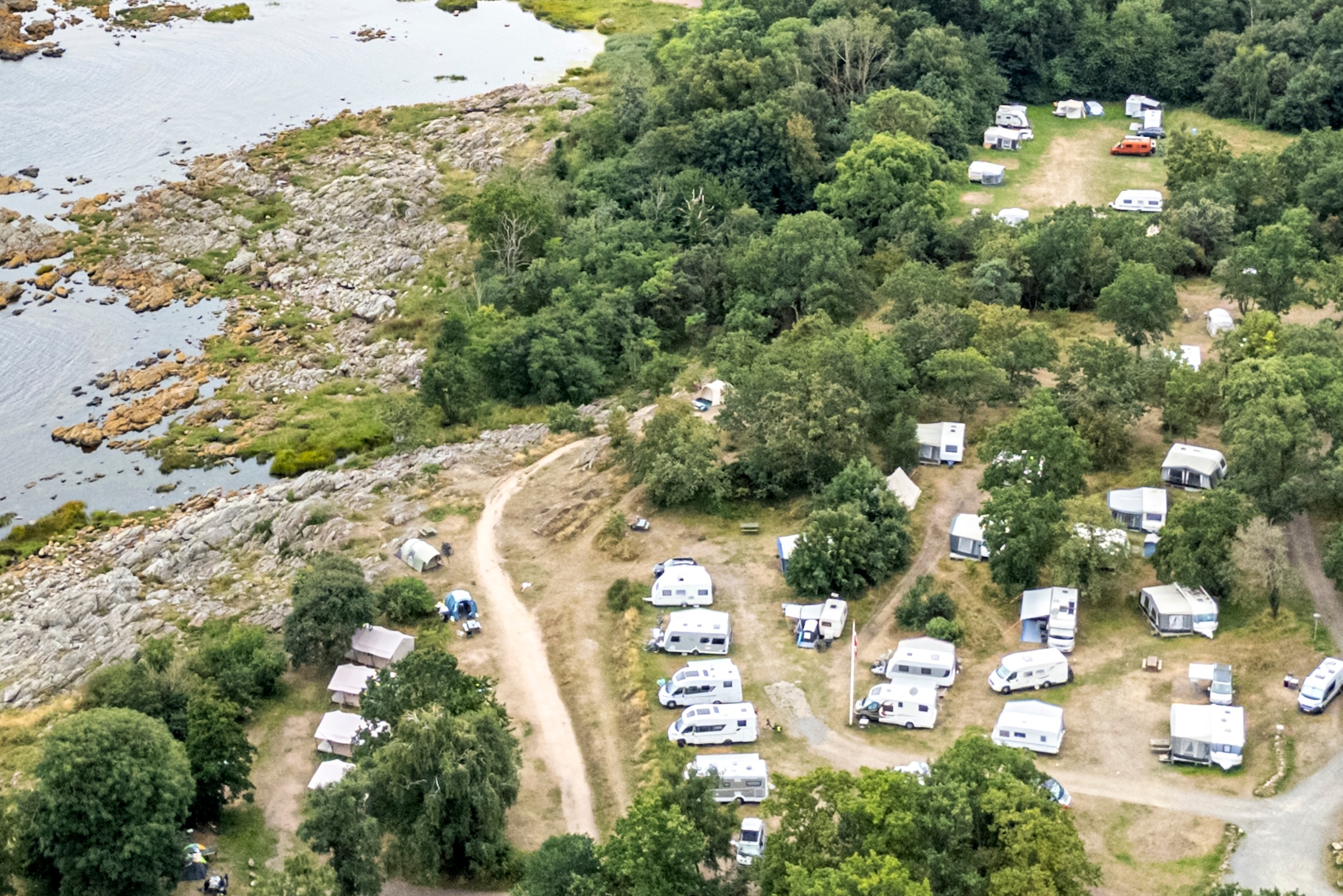
Hullehavn Camping near Svaneke (Sydskovvej 9, 3740 Svaneke) sits directly on the Baltic Sea and is a quieter, family-run site with around 100 pitches and 18 rental accommodations. Contact: tel. +45 56 49 63 63, [email protected].
DCU-Camping Rønne Strand - Galløkken is on the beach just minutes from Rønne town centre, with 94 tourist pitches, 12 seasonal pitches and 17 rental accommodations. The 2026 season runs from 14 March to 26 October. Further south, more sites round out the picture, including Møllers Dueodde Camping near Dueodde beach with a heated pool, plus sites near Balka, Snogebæk and Nexø.
Prices and booking
A night's camping is made up of several elements almost everywhere: a per-person fee, a pitch fee, and usually electricity billed separately. At Hullehavn in 2026, an adult costs 115 DKK, a child 65 DKK, a pet 30 DKK and electricity 50 DKK a night; the pitch itself ranges from 30 to 145 DKK for a tent and 50 to 145 DKK for a caravan or motorhome, depending on size and season.
In concrete terms, a family of two adults and two children in their own motorhome at Hullehavn in peak season pays around 590 DKK a night, roughly €79. In the off-season it gets noticeably cheaper, since pitches start from as little as 40 to 50 DKK. Across the island, family budgets average roughly €25 to €40 a night. Rental cabins and huts start at around 480 to 600 DKK a night for four to five people, and safari or glamping tents cost between 785 and 1,275 DKK.
Seasonal pricing shifts things noticeably. At Hullehavn, peak season runs from 29 June to 10 August, mid-season covers June and 10-31 August, and low season runs from April to June and from late August to late September. Travelling during school holidays or on public holidays calls for early booking, exact daily rates and availability are only shown in each site's own booking system. The same applies when booking the ferry.
Arriving by motorhome or caravan
Bornholm is reached by ferry, operated by Bornholmslinjen. From Germany, the direct Sassnitz (Rügen) - Rønne crossing at around 3 hours 20 minutes is the shortest option. From Sweden, the fast ferry Ystad - Rønne takes about 80 minutes, and from Zealand, Køge - Rønne takes around 5 hours 30 minutes. Book via bornholmslinjen.de, customer service +45 70 900 100. More detail is in the guide to getting there.
For the Sassnitz - Rønne route, 2026 car fares are tiered: Lowprice from 699 DKK (around €94, maximum vehicle height 1.95 metres), Flex from 999 DKK, and the refundable Standard fare from 2,599 DKK. Motorhomes, caravans and trailers are all carried; trailers sometimes travel free in the low season, and up to 599 DKK in peak season (roughly 8 June to 9 August 2026). Important: the vehicle's dimensions must be entered correctly at booking, or you risk problems at the port.
Wild camping and nature camps
Unlike Sweden or Norway, Denmark has no general right-to-roam. Free camping on Bornholm is banned in principle, but wild camping is allowed in four designated Naturstyrelsen forests: Rø Plantage in the north, Blykobbe Plantage between Rønne and Hasle, Pedersker Skov in the south, and Nord-Almindingen between Bolsterbjergvej and Aasedamsvej.
The "1-2-3 rule" applies there: no more than one night in the same spot, and a maximum of two tents of the 3-person type. Fixed conditions also apply:
- No open fires except at designated fire pits.
- Pitch out of sight of houses or roads.
- No camping on beaches, dunes, meadows, heathland or fields.
- Take rubbish with you, and motorised traffic on forest tracks is banned.
Wild camping is free and needs no booking. The island also has more than 23 shelters and primitive overnight spots, including at Finnedalen, Ravnedalen, Lynggaardsskoven and the Tanghytten at Blykobbe. Most sleep five to eight people; some work on a first-come, first-served basis, while others can be booked online via udinaturen.dk and booking.naturstyrelsen.dk. Shelters on Naturstyrelsen land cost 0 to 30 DKK a night, municipal or private ones up to around 100 DKK. Larger groups and school classes can pre-book spots such as Rundemose or Finnedalen. Individual shelters vary in build, some are open lean-tos, others have walls.
Weather and the best time to visit
Bornholm is known as Denmark's "sunshine island", with around 1,580 hours of sunshine a year according to figures attributed to the Danish Meteorological Institute (DMI), more than the rest of Denmark. From May to July the sun shines for over seven hours a day on average, and Svaneke is considered Denmark's sunniest place.
The warmest months are July, averaging 20.3°C, and August at 19.7°C; June sits at 17.6°C and September at around 15°C. The Baltic Sea reaches about 13 to 14°C in June, 16 to 18°C in July and August, and often 20 to 22°C close to shore; in September it's still 15 to 17°C. Most campsites open from late March or April through to September or October. For quieter camping in still-mild weather, June and September are good choices. More detail is in the guide to weather.
Camping with a dog
Bornholm is dog-friendly, and most campsites welcome pets, often for a small fee, around 30 DKK a night at Hullehavn. Dogs are also allowed on board the ferry.
On beaches, Denmark-wide rules require dogs to be kept on a lead from 1 April to 30 September; from 1 October to 31 March they may run free under control. In forests, nature reserves and vegetated dunes, dogs must be kept on a lead year-round, and Blue Flag beaches don't allow dogs at all. This is set out in Danish nature protection law, enforced by the Naturstyrelsen. More detail is in the guide Bornholm with dogs.
Exploring the island from your campsite
Bornholm has around 158 kilometres of coastline, granite cliffs in the north, long white sandy beaches such as Dueodde in the south. From a pitch, the island is easy to explore by bike; a dense network of largely car-free paths links the coastal towns. Those travelling with a tent or bike can plan their route from site to site and shelter to shelter; concrete routes are in the guide to cycling.
The beaches themselves range from fine sand in the south to rocky coves in the north, an overview of the best stretches is in the beaches hub. Most sites also put the island's attractions within easy reach, from Hammershus to the coastal towns of Gudhjem, Svaneke and Allinge with their smokehouses.