
Running on Bornholm
Running on Bornholm, beach trails, Almindingen forest and the coastal path, plus Etape Bornholm, the Salomon Hammer Trail and the best running season.
Contents
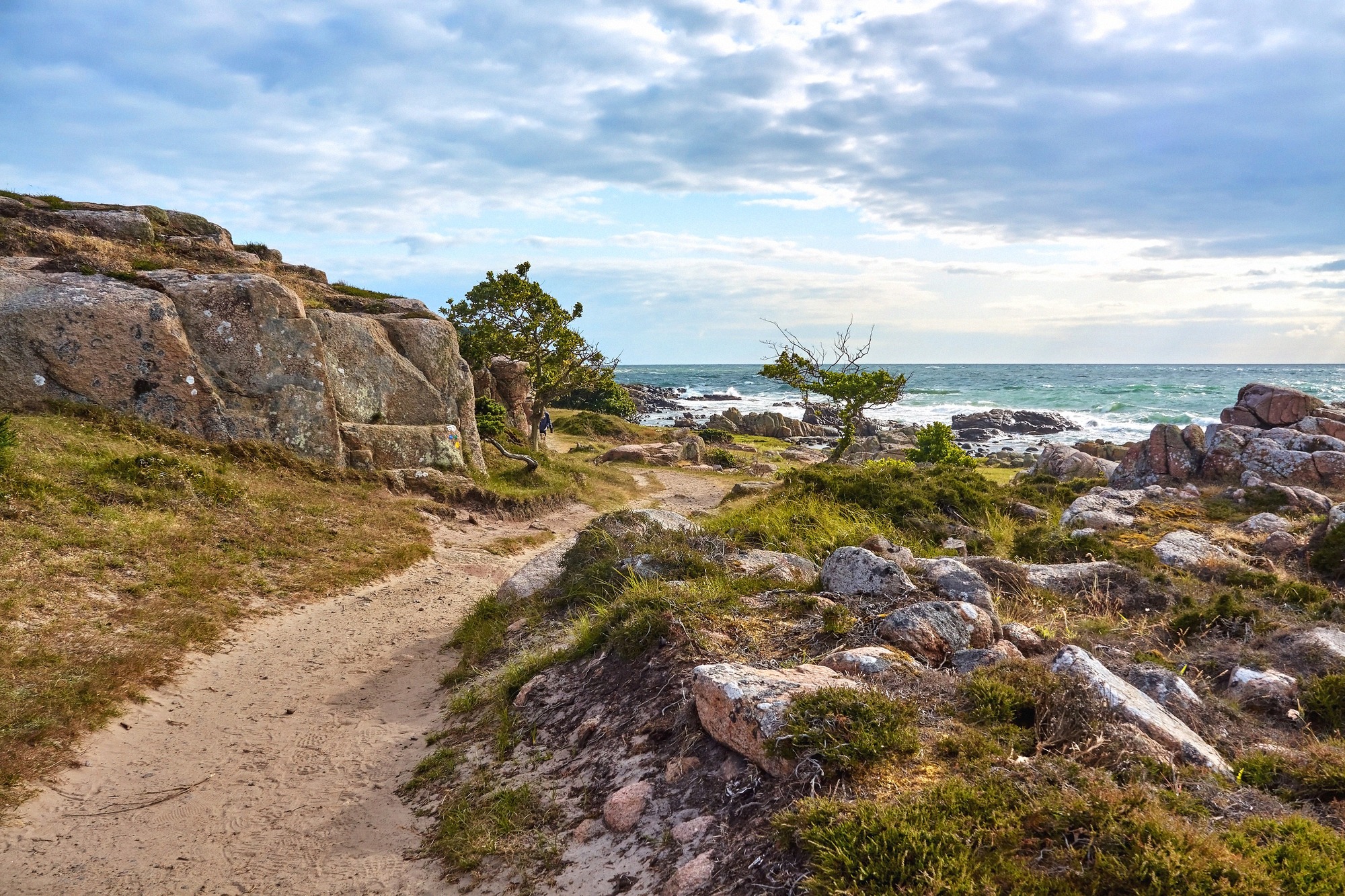
Bornholm packs remarkable variety into a small area, fine sandy beaches in the south, the island's largest forest at its centre, and a rugged granite coastline in the north. Pack your running shoes for a Bornholm trip and you'll find everything from flat beach running to technical trail, plus a packed race calendar. This guide covers the main routes, the big events and the practical questions around a running holiday here.
Climate and the best running season
Bornholm is Denmark's sunniest region. Over the long-term average the island gets around 1,580 hours of sunshine a year, well above the national average of about 1,495 hours; in 2024 the Danish Meteorological Institute recorded as many as 1,989 hours. The island also has Denmark's fewest rainy days, at around 103, with July and August especially sunny and dry, good conditions for reliable training.
Mean daily temperatures in summer run around 19 degrees, about 20 in July. Spring sees 8 to 9 degrees, autumn around 12, winter 2 to 3; the annual daily average is about 10.5 degrees. In practice, that makes May to September the most comfortable running window. September is particularly appealing, since temperatures are still summery but the peak season crowds have thinned and the paths are quieter. Pack a light windproof jacket even in summer, the sea breeze can bite.
Beach routes
The south coast is Bornholm's beach territory. The island's widest continuous stretch of sand runs for around 12 km from Boderne in the west eastward to Balka, taking in the famous Dueodde along the way. The sand at Dueodde, at the southern tip, is so fine and pale it was once used in hourglasses; boardwalks over 500 m long lead from the car park through the dunes to the water.
Running on this soft sand takes noticeably more effort than on firm ground and puts extra strain on muscles, ligaments and tendons. If you're not used to it, keep the first beach runs short and stick to the firmer, damp sand closer to the water. There are car parks along Fyrvejen and Skrokkegårdsvej, and by the Krølle-Bølle kiosk; outside peak season a space is usually easy to find. The fine-sand Balka beach at the eastern end of the bay makes a good turnaround or starting point.
Forest and hills in Almindingen
For varied terrain, head inland. Almindingen, at around 60 km², is Bornholm's largest forest and Denmark's third-largest. The key base for runners is the Rytterknægten trail centre, also a meeting point for horse riders, cyclists and walkers; right next to it, at 162 m, sits Rytterknægten, the island's highest point.
A good introductory loop links Ekkodalen (Echo Valley) with the Rytterknægten trail centre, just under 2 km each way, technically easy, on a mix of wide forest tracks, narrow paths and grass trails. Near Næsse the ground can turn boggy and muddy after rain, so firmer shoes are worth it following wet weather. The route can be extended into longer loops as you like; official sources don't give reliable distances or surface details beyond this core stretch, so a mapping app on the ground is your best guide there.
The Kyststien coastal path
The Kyststien coastal path circles the entire island for around 120 km and is officially split into seven stages: Rønne-Hasle, Hasle-Sandvig, Sandvig-Gudhjem, Gudhjem-Svaneke, Svaneke-Snogebæk, Snogebæk-Boderne and Boderne-Rønne. The path is well marked and follows the coast clockwise. For runners, individual stages work better as training runs than the full circuit.
The most spectacular stage scenically is Sandvig-Gudhjem in the north: it runs along the island's most dramatic rocky coastline, passing the Hammershus castle ruin and the Helligdomsklipperne cliffs. It's also the most technically demanding, rocks, roots and elevation changes make some sections notably tougher than the rest. Sources don't give exact stage lengths in kilometres or an official difficulty rating per section, so plan conservatively and wear proper trail shoes. If you'd like to combine running with hiking, the activities on Bornholm guide covers the island's other long-distance paths.
Paths, signage and orientation
Away from beach and trail, Bornholm has a dense network of paved cycle paths and gravel tracks that work well for running too. The cycle paths ("cykelveje") here carry dark green signs, elsewhere in Denmark they're blue, marked with destinations and distances, so getting lost is unlikely.
The backbone of the network is the national Cykelrute 10, "Bornholm Rundt", at 104 km the shortest national cycle route in Denmark, supplemented by regional routes numbered 21 to 26. Many of these tracks follow old railway lines, so gradients are gentle, pleasant for steady-state runs. Details on the individual routes and stages are in the cycling on Bornholm guide. In summer you'll share these paths with cyclists and walkers, but the network is dense enough that everyone finds their own stretch.
Running events
Bornholm has a surprisingly packed race calendar. The main public race is Etape Bornholm, running Monday 20 to Friday 24 July 2026, with a start each day at 18:00. Over the five days, adults cover a combined marathon distance of 42.195 km, organised by Viking Atletik. Confirmed stage lengths are Stage 1 (Monday, 10 km), Stage 3 (Wednesday, 7.8 km) and Stage 5 (Friday, 10 km); children run shorter versions of 2.9 to 4.2 km. The entry fee for the five stages ranged from 600 DKK (booked by the end of August 2025) to 885 DKK (from July 2026), with single stages costing 130 to 180 DKK; registration runs through etape-bornholm.dk and Sportstiming. Book early if you want a place, as of June 2026 the adult 5-day category and several other categories were already sold out.
The Salomon Hammer Trail is billed as Denmark's toughest trail race, organised by the Tejn IF club in northern Bornholm. The spring 2026 edition runs on Saturday 2 May, starting and finishing at Sænevej 5 in Allinge. On offer are 50 miles (+3,310 m elevation), 50 km (+2,210 m), 25 km (+1,100 m), 17 km (+600 m) and 8 km (+400 m), plus walking versions over 8, 17 and 25 km; the 25 km race also served as the Danish short-trail championship. Minimum age is 18 for the longer distances and 15 for the half marathon distance; there are no formal entry requirements, but trail experience is recommended for the longer races. There's also a winter edition (31 January 2026, also in Allinge) with distances from 10 km through half marathon, marathon and 63 km up to 50 miles (84 km); entry fees for that edition ranged from 200 DKK (10 km) to 800 DKK (50 miles), depending on distance and booking date.
A local curiosity is the Svaneke Øl-Marathon, traditionally held right after Etape week and sponsored by the organic Svaneke Bryghus brewery. The same brewery also sponsors Etape Bornholm itself, with an alcohol-free sample at bib pickup and draught beer at the finish. The marathon usually starts just north of Svaneke, amid a landscape dotted with burial mounds; the marathon typically starts at 11:00, with the quarter and half marathon at 13:00, and every finisher gets a medal and a beer. For 2026, though, the date and details haven't been officially confirmed. For other dates on the island, see the events on Bornholm guide.
Getting there and practicalities
You don't need a car for a running holiday here. The fastest ferry links Ystad in Sweden with Rønne in around 80 minutes, with up to 16 sailings a day in peak season (Bornholmslinjen). Longer crossings run from Køge in Denmark (around 5.5 hours) and from Sassnitz in Germany (around 3 hours 20 minutes). From Copenhagen, Bornholmerbus coach services such as route 866 cross the Øresund Bridge to Ystad, connecting with the fast ferry. Quicker still is the DAT flight from Copenhagen (CPH) to Rønne (RNN), taking around 35 minutes. Once on the island, the public Bornholmerbus service gets you to the start of the main routes. All the options and their prices are covered in the ferries to Bornholm and flights to Bornholm guides, and in the getting to Bornholm overview.