
Sailing to Bornholm
Harbours, 2026 mooring fees, tricky rock harbours and the side-trip to Christiansø, the practical sailing guide for the Bornholm cruising ground in the Baltic.
Contents
Bornholm sits in the middle of the southern Baltic, within a day's sail from several directions, from Rügen (Sassnitz or Lauterbach) it's around 50 nautical miles to the main town of Rønne, with Greifswald and Peenemünde serving as alternative departure or stopover harbours for sailors making the crossing. The cruising ground pairs one large, well-equipped marina with a string of small rock harbours and the remote natural harbour of Christiansø. This guide brings together what you need before and during the passage, harbours, fees, weather and the pitfalls of the east coast.
2026 harbour fees, tiered by length
Bornholm's municipal harbours bill 2026 visitors on a single tariff tiered by boat length. It applies at Rønne (Nørrekås), Gudhjem, Svaneke and Allinge, among others, and is set out in the official Region Bornholm tariff sheet. Power, water and a shower or bath are already included in the price, which keeps the budgeting simple.
- Under 7 m - 175 DKK per night
- 7 to 10 m - 273 DKK
- 10 to 13 m - 343 DKK
- 13 to 16 m - 440 DKK
- 16 to 20 m - 531 DKK
- 20 to 30 m - 769 DKK
- Over 30 m - 1,090 DKK
The tariff sheet only lists per-night rates; it gives no reliable multi-day discounts for Bornholm's harbours. Anyone planning a longer stay in one harbour is best off asking the harbourmaster directly.
Rønne Nørrekås, the main base
Rønne Lystbådehavn, in the Nørrekås bay, is the island's largest marina and holds a Blue Flag award. It has around 100 visitor berths, and the facilities cover almost everything a cruising base needs - 230 V and 400 V power, water, Wi-Fi, diesel and petrol, a boatyard, and washrooms with washing machines. The town centre is only about 400 m away, putting shops, restaurants and museums within walking distance.
- Address - Bådehavnsvej 13, 3700 Rønne
- Harbourmaster - +45 56 92 23 20
The boatyard in Rønne handles smaller repairs and stocks chandlery supplies. Sailors who need Danish charts on board should buy them before the height of summer, stocks on the island often sell out at peak season. The relevant chart for this ground is BSH chart No. 138, "Bornholm bis Öland und Ławica Słupska (Stolpebank)"; Germany's BSH is gradually switching its paper charts over to international (INT, A1) formats.
The rock harbours of Gudhjem and Svaneke
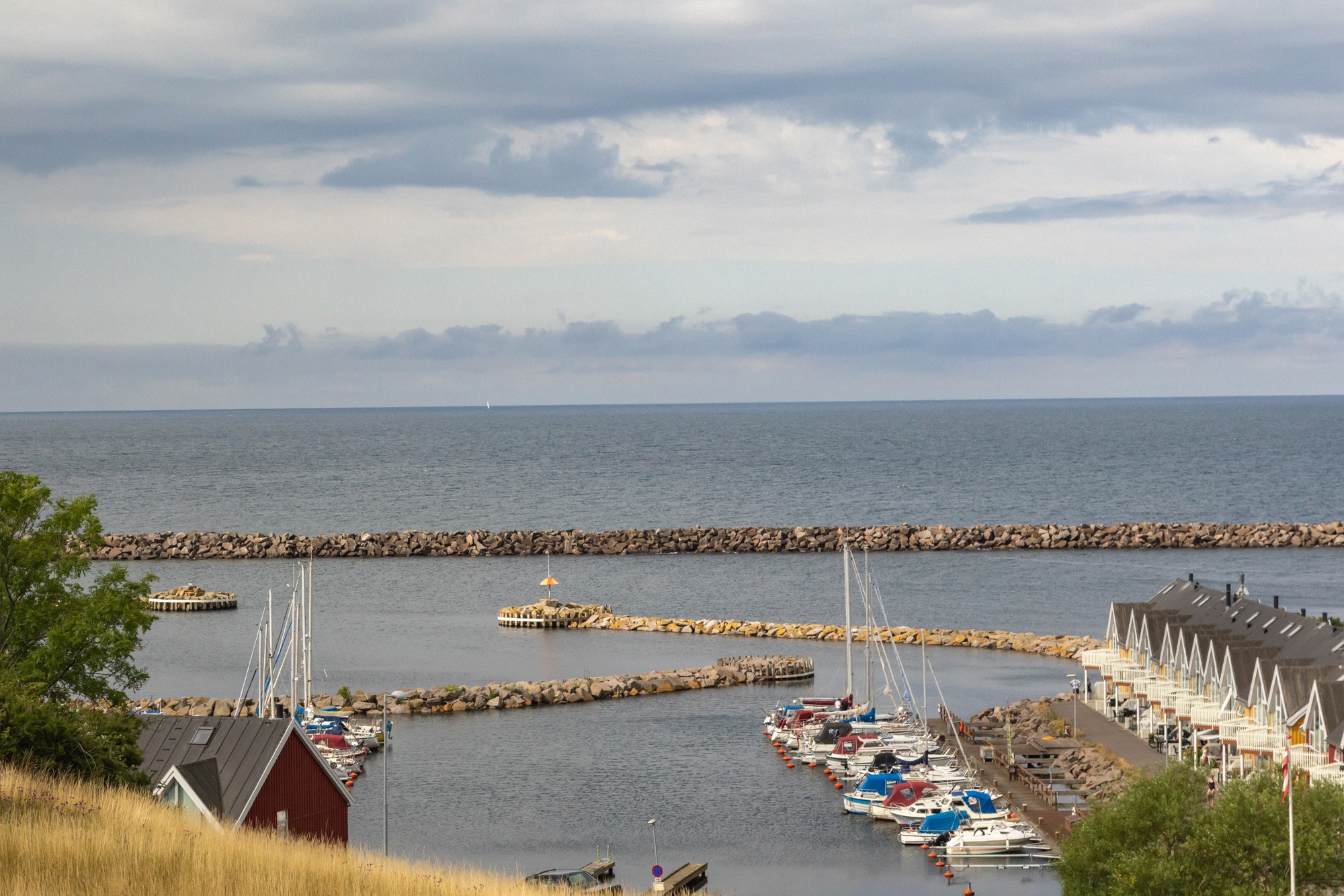
The classic Bornholm harbour is a rock harbour cut into the granite, picturesque, but demanding in an onshore wind. As a rule, Gudhjem and Svaneke both call for experience, and in strong winds from easterly directions, swell makes the approach and entrance genuinely challenging. Extra caution is needed on this side of the island.
Gudhjem has a narrow entrance between rocks, approached from the east. Unmarked rocks lie close to the approach, over which the sea breaks in an onshore wind, it's essential to hold the marked approach line. In onshore winds above 10 m/s, the usable berthing capacity is reduced. The harbour of Nørresand, blasted into the rock a little to the north, serves as a fallback and refuge harbour. The pontoons have 230 V power and a payment machine, but water only at a few points; washrooms are in the red harbour building, which also houses the harbourmaster's office and tourist information. The town has two larger supermarkets and a smokehouse. The harbour address is Ejnar Mikkelsensvej 25, 3760 Gudhjem (tel. 56 92 23 36). More on the town in the Gudhjem guide.
Svaneke consists of an inner harbour and two outer basins. In strong east, north-east and south-east winds, swell makes the outer basins very rough; the lock gate to the inner harbour is closed in onshore gales. Anyone sailing in an easterly wind is better off making for nearby Listed than Svaneke. Provisioning is good: a well-stocked supermarket is within walking distance, along with the Svaneke Brød bakery and a fish workshop at the harbour; a smokehouse (røgeri) sits about 500 m to the north.

Climate, wind and the best sailing season
Bornholm's weather is comparatively steady across the season. From May to August, wind averages around Beaufort 3 and varies little through the year, which makes day passages easy to plan. Autumn and winter bring occasional stronger winds, sometimes gale-force, felt most on the north coast. The summer months are clearly the calmest and most reliable time to sail; sailors wanting to avoid crowded harbours can shift towards the edges of the season instead.
For planning on board, don't rely on the yearly average alone. Official sea forecasts and Beaufort station reports for the Baltic, including the Bornholm and Arkona seas, are issued by Germany's DWD, and Denmark's DMI provides forecasts specifically for the Bornholm region. It's worth checking wind direction and strength before approaching the east coast's rock harbours in particular. For a general sense of the island's climate, see the Weather on Bornholm guide.
Christiansø, the natural harbour of the Ertholmene
About 10 nautical miles north-east of Bornholm's north-east coast (Gudhjem) lie the small islands of Christiansø and Frederiksø - Denmark's easternmost point. Their natural harbour, between the two islands, has two entrances, one on each side of the swing bridge, so it can be entered from any wind direction. A closed entrance is signalled by three hanging lanterns or a black ball. Around 2,000 yachts moor here each year.
For boats under 20 tonnes, no booking is needed; boats over 20 tonnes must book in advance. The mooring ticket is bought from the machine on the north wall of the harbour office (harbourmaster tel. +45 4045 2014, office hours 16:00-17:00). A few rules apply: fresh water is only available from the public taps, filling tanks is not allowed, the harbour speed limit is 3 knots, and swimming is prohibited. Historically, the islands relied on rainwater wells for their drinking water supply. Facilities include toilets, bathing spots, barbecues, gas, power, a playground and shops.
Ashore, it's worth visiting the museum in the two towers, Store Tårn and Lille Tårn (admission 40 DKK for adults, 20 DKK for children aged 6 to 15). Opening hours vary by season, daily 8:00-19:00 at the height of summer (18 June-18 August), shorter at the edges of the season. On Frederiksø there's also the "Ballonen" prison museum, with free admission year-round and a small exhibition on the political prisoner Dr Dampe, whose cell is shown as a reconstruction. More on the islands themselves in the Christiansø guide.
Reaching Christiansø without your own boat
Anyone without their own keel can reach the Ertholmene islands on the Christiansøfarten excursion boat, departing only from Gudhjem. The former fast-ferry route via Allinge has been discontinued; free buses now run from Allinge to Gudhjem in high season instead. Christiansø itself is car-free and protected as a nature and heritage site.
The 2026 timetable is tiered by season:
- High season (27 June-23 August), three departures from Gudhjem at 10:00, 12:30 and 15:00; return from Christiansø at 14:00, 16:30 and 19:30. Tuesday to Thursday during high summer (7 July-6 August), an additional evening sailing departs at 15:00.
- Shoulder season (20 April-18 May and 18 September-18 October), one departure at 10:00, returning at 14:00.
- Early season (30 March-19 April), departure at 10:00, returning at 13:30.
The return fare varies by season: in winter (1 January-19 April and 19 October-31 December) 220 DKK for adults and 120 DKK for children, in summer (20 April-26 June and 10 August-18 October) 260 DKK and 145 DKK, and in high season (27 June-9 August) 320 DKK and 180 DKK. Children aged 0 to 5 travel free year-round. Tickets for the island museum are sold at the Gudhjem ferry terminal, on board the boats, at the island kiosk and at the tourist information office, among other places. For an overview of all the connections to and around the island, see the Ferries to Bornholm guide.