
The Smokehouses of Bornholm
Golden smoked herring is Bornholm's speciality. Around a dozen smokehouses welcome visitors, with seasonal hours, prices and tips at a glance.
Contents
The Bornholmers can turn silver into gold: they let silver herring air-dry for a few hours, hang them on iron rods over smouldering alder wood, and keep the smoke and temperature in the kiln under 80 degrees. After about four hours, the fish have turned to gold, across Denmark, they're simply known as "Bornholmers". Around a dozen smokehouses (røgerier) keep this craft alive in 2026, most of them doubling as restaurant, shop and harbourside meeting point.
A tradition going back to the Middle Ages
Smoking fish has a long history on Bornholm. As far back as the Middle Ages, the island's fishing villages had numerous small smoking chambers, almost every family in the harbour towns had one. Legend has it that Scottish fishermen, who put in at the rocky island of Christiansø while fishing these waters, brought the technique of smoking in open chimneys with them. In 1866, the island's first large-scale smokehouse opened in Gudhjem, and fish has been smoked there without interruption ever since.
At its peak, several hundred smoking chambers stood on the island. Most of the chimneys today are simply relics of a bygone era, some have become souvenir shops, others artists' studios, holiday flats or garden sheds. What was once the centre of the Baltic herring trade has shrunk to a modest number of active smokehouses, but the craft itself has survived: over alder wood, with carefully tended smoke, often still in the hands of the same family across several generations.
Sol over Gudhjem, the dish and the festival
No visit to Bornholm is complete without "Sol over Gudhjem" ("Sun over Gudhjem"). This open sandwich consists of warm, freshly smoked herring on a slice of dark rye bread, topped with chives, radishes and onion rings, crowned with a raw egg yolk representing the sun. It's a classic choice for "frokost", as the Danes call their light midday meal. The name is generally credited to Oskar Davidsen, the legendary Copenhagen smørrebrød restaurateur, though the exact story behind it has been passed down rather than documented.
The dish has long since grown into a festival too. Since 2009, top chefs from across Denmark have competed at Gudhjem harbour in a cooking contest using local produce - "Sol over Gudhjem" is now considered Denmark's largest food festival. It now runs over two days: in 2026 it takes place on 19 and 20 June, admission is free, and TV2 Bornholm broadcasts the event. Anyone on the island in June should pencil in the weekend. More dates throughout the year are listed in the Events guide.

The smokehouses at a glance, from north to south
Among the smokehouses still operating, some run as restaurants, some as pubs with live music in the evening, and others as rustic delicatessen stalls. One quirk of the business structure is worth knowing: the three smokehouses in Gudhjem, Allinge and Snogebæk belong together under the umbrella of Bornholmer Røgerierne (smokedfish.dk). All three offer an all-you-can-eat fish buffet, have live music on summer nights, and take no bookings whatsoever. Here are the best-known houses, starting from Allinge in the north and working round the island:
- Allinge Røgeri (Sverigesvej 5, 3770 Allinge), somewhere between a pub and a beach bar, with plenty of live music. Open from late March to 16 October in 2026, fish buffet 195 DKK, no bookings.
- Nordbornholms Røgeri (Kæmpestranden 2, 3770 Allinge), a large smokehouse on the southern edge of Allinge with the island's best fishmonger's counter, where many locals shop too. The restaurant sits right on the cliffs. Open year-round: restaurant daily 11:00-21:00, shop 9:00-18:00; booking possible.
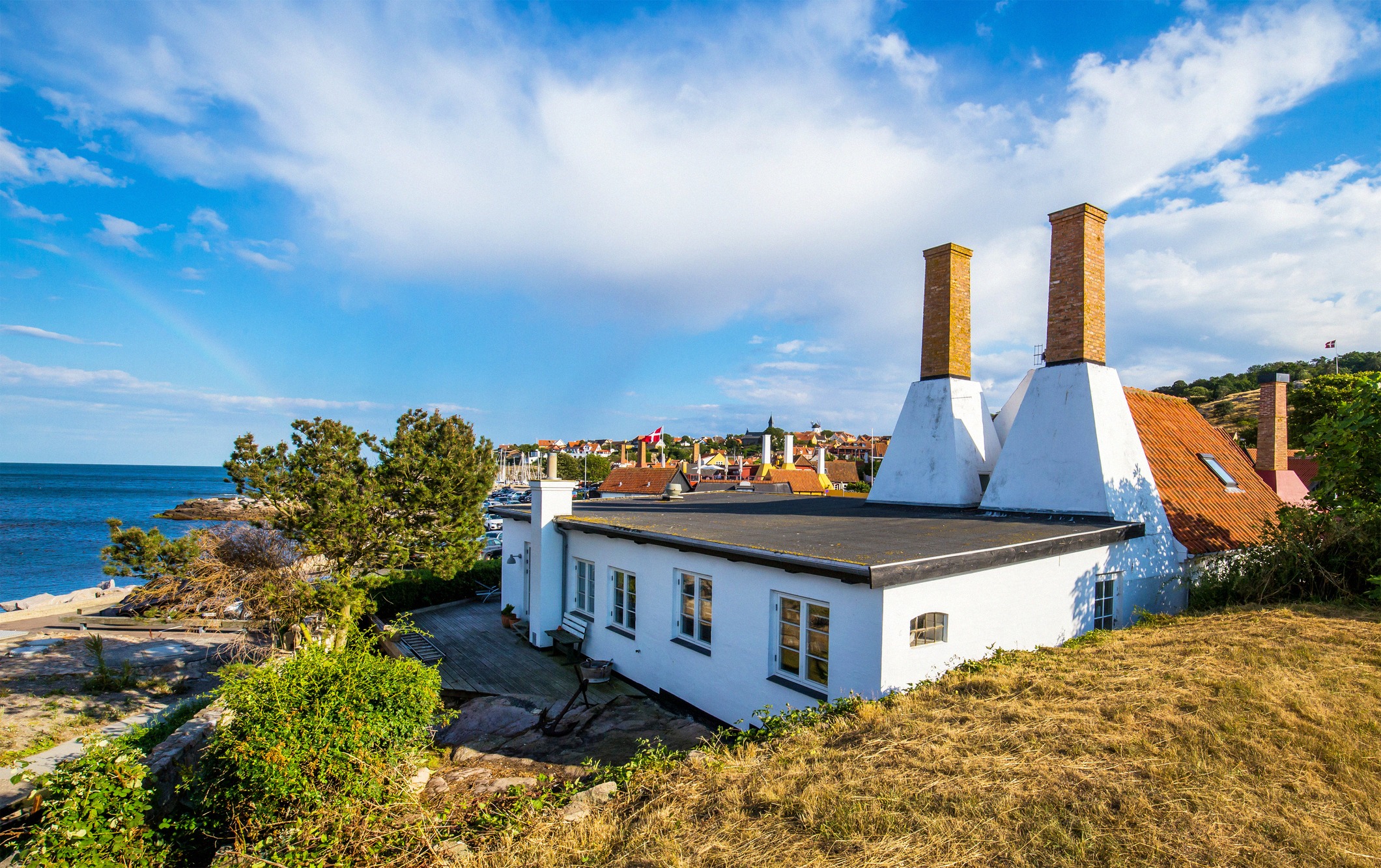
- Gudhjem Røgeri (Ejnar Mikkelsensvej 9, 3760 Gudhjem), the yellow ensemble with the distinctive chimneys down by the harbour. The current building dates from 1910 and is the oldest working herring smokehouse on the island, the most authentic place for a Sol over Gudhjem. Open from 21 March to 16 October in 2026, daily 10:00-21:00, fish buffet 195 DKK, no bookings.
- Svaneke Røgeri (Fiskergade 12, 3740 Svaneke), the five smoking chimneys standing side by side are a Svaneke landmark. A family business since 1919, with the craft now passed down to a fourth generation. Set on rocks overlooking the Baltic, with outdoor picnic tables. Seasonal.
- Årsdale Silderøgeri (Gaden 2, Årsdale, 3740 Svaneke), a small, family-run smokehouse in the harbour village south of Svaneke, now in its third generation. Terrace views over the beach and the Baltic. Usually open all year, with a winter break.
- Nexø Gamle Røgeri (Stenbrudsvej 22, 3730 Nexø), a charming smokehouse on the northern edge of Nexø with a large terrace and sea views. Fish isn't the only thing smoked here, cheese, sausage, chicken and ham are too. Has a children's playground. Seasonal.
- Snogebæk Røgeri (Hovedgaden 6, Snogebæk, 3730 Nexø), a modern smokehouse with a fish shop in the picturesque fishing village south of Nexø. Open from late March to 17 October in 2026, fish buffet 195 DKK, no bookings.
- Bakkarøgeriet (Østre Sømarksvej 29, 3720 Aakirkeby), perched above the small harbour of Østre Sømarken, running since 1938. A cult favourite is the summer concert series by Icelandic musician Siggi Björns, who continues to play in 2026, season opener on 13 July, with a special Sankt Hans performance on 23 June. Seasonal.
- Arnager Røgeri og Restaurant (Arnagervej 4, 3700 Rønne), tucked away behind Rønne Airport, a popular family restaurant with a large garden; children who aren't keen on smoked fish can order something else. Seasonal.
- Hasle Røgerierne (Søndre Bæk 20, 3790 Hasle), nowhere else on the island are so many smoking chimneys clustered together, set along the cliffs on the southern edge of Hasle. This is the island's last smokehouse still using open chimneys and alder wood, a living museum with a fish shop attached. Open from Easter to the autumn half-term in 2026, with fish usually ready from around 10:00; online booking possible.

Which smokehouse suits you?
The smokehouses each have their own character, a rough guide based on each house's known strengths, not an official ranking:
- Authenticity and history: Gudhjem Røgeri (in its 1910 building) and Hasle Røgerierne, with their open chimneys, show the craft in its most traditional form.
- Shopping like a local: Nordbornholms Røgeri in Allinge has the island's best fishmonger's counter and is open year-round, this is where the local trade stocks up too.
- Families with children: Arnager, near Rønne, has a large garden and alternatives to smoked fish; Nexø Gamle Røgeri has a playground.
- An evening with music: Gudhjem, Allinge and Snogebæk have live music on summer nights, while Siggi Björns plays his summer concerts at Bakkarøgeriet.
The red cousin, and an honest word about herring stocks
Alongside the golden Bornholmer there's a red variety: Christiansø herring, cured in a secret herb brine. To carry that name, it must come from Christiansø itself - Ruths Kryddersild meets that requirement and continues to be produced in 2026, sold among other places at the Nordbornholms Røgeri shop. There's also a well-known counterpart made on the Bornholm mainland, Christiansøpigens Sild ("Christiansø Girl's Herring"), made by hand in Svaneke; the naming rights between the two were long disputed.
One thing shouldn't be glossed over: herring is getting scarcer. Baltic Sea stocks have been in crisis for years, the MSC warned of a possible collapse in 2023 and called for sharp quota cuts. For 2024, the European Commission proposed a bycatch limit of just 1,000 tonnes; member states ultimately settled on 55,000 tonnes. Bornholm, once a stronghold of European herring fishing, has for years had to import herring from Denmark's west coast and from Norway. It's still smoked on the island, though, and the distinctive taste remains.
Practical tips for your visit
Most smokehouses open around Easter and stay open until after the autumn half-term in late October; Nordbornholms Røgeri in Allinge is open year-round, and Årsdale is usually open with just a winter break. Anyone visiting the smokedfish.dk houses (Gudhjem, Allinge, Snogebæk) during the peak season of July and August should come early, since none of them take bookings. Nordbornholms Røgeri and Hasle Røgeri, by contrast, accept online bookings, which is worth using for groups.
A single warm herring to eat by hand costs just a few kroner, and the all-you-can-eat fish buffet is 195 DKK. The fish tastes best fresh from the smoking chamber, served wrapped in stiff paper with a little coarse salt, a cold Bornholm beer goes down well alongside it.
Getting there: the BAT bus network, with nine routes running from Rønne, is timed to connect with the ferries; route 1 links Rønne with Allinge and Gudhjem, and route 3 serves Gudhjem harbour. Cycling is an even nicer way to travel - Bornholm's well-developed network of paths, some following old railway lines, connects the harbour towns with the smokehouses, and taking a bike on the BAT bus has been free since 2024. More on this in the Cycling on Bornholm guide. To see where smoked herring fits into the island's wider food scene, see the Food and Drink on Bornholm guide.