
Getting to Bornholm by train
Travelling to Bornholm by train, comparing three routes via Sassnitz, Ystad or Køge, with journey times, connecting ferries, prices and combined-ticket tips.
Contents
Bornholm has no rail link of its own, the island sits out in the middle of the Baltic Sea. "By train" therefore always means train to a ferry port, then a crossing. From Germany and beyond, three combinations make sense: via Sassnitz on the island of Rügen, via Ystad in Sweden, or via Køge near Copenhagen in Denmark. Which route works best depends mainly on where you're starting from. This overview compares journey times, connecting ferries and prices for all three.
Via Sassnitz, the direct route from Germany
The route via the Sassnitz/Mukran ferry terminal on Rügen is the only one that avoids a detour through a neighbouring country entirely. By train, you travel to Stralsund and on towards Rügen; the final leg to the ferry is covered by the RE27 line operated by Hanseatische Eisenbahn. The Sassnitz/Mukran-Rønne ferry, the M/S Hammershus, crosses the Baltic in 3 hours 20 minutes.
Important: this train-to-ferry connection is seasonal. In 2026 the RE27 runs to the ferry from 13 May to 17 October, on core days Monday, Thursday, Saturday and Sunday, with an extra shuttle between Sassnitz and Bergen on some weekends. The ferry itself also runs seasonally, roughly from April to December, up to six times a week, not year-round. Travelling outside this window means using one of the other routes instead.
From Berlin, this route is the fastest. A concrete 2026 connection leaves Berlin Hauptbahnhof at 06:33 and reaches Bornholm at 15:10, changing at Stralsund and Bergen, around 8.5 hours door to door including the ferry. The return leaves Bornholm at 08:00 and is back in Berlin by 16:14. That makes the Sassnitz route quicker than travelling via Ystad and Copenhagen. Germany's Deutschlandticket is valid on the regional trains to the ferry; the ferry ticket itself has to be bought separately.
Via Ystad, the most flexible option from Hamburg
Travelling from Hamburg or western Germany, the route via Sweden is usually the most convenient. The first leg runs by train to Copenhagen, then across the Øresund Bridge to Malmö C, Hyllie or Triangeln, followed by the Skånetrafiken Pågatåg regional train on to Ystad. From Copenhagen, this rail leg takes around 3 hours 45 minutes, before the ferry crossing.
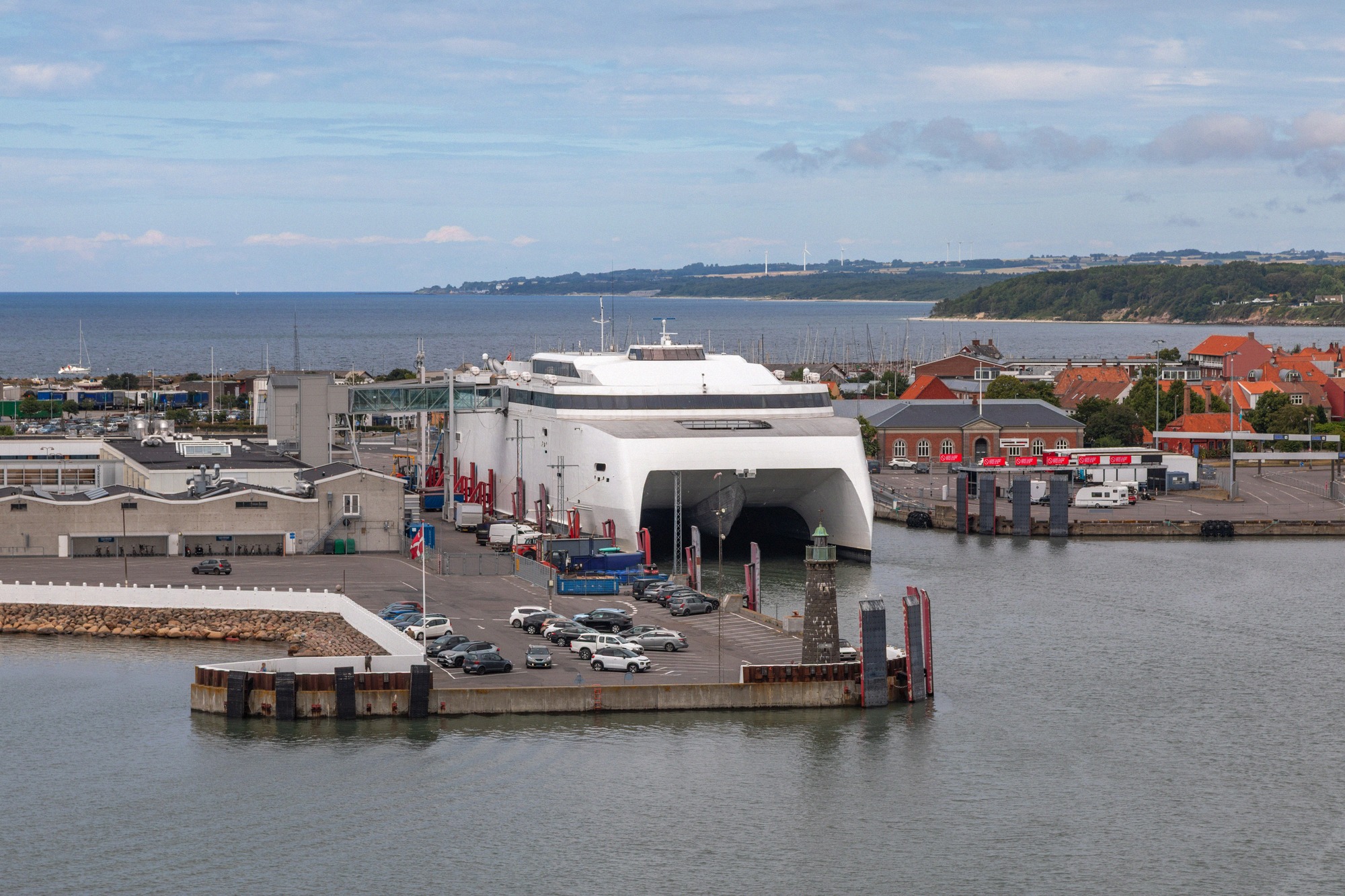
The Ystad-Rønne ferry is the workhorse connection to Bornholm: the high-speed catamarans (Ferry Express 1 and Express 5) take just 1 hour 20 minutes and run year-round, with several departures a day, up to around eight. In high season the schedule is topped up by the conventional ferry M/S Povl Anker, which takes around 2.5 hours to cross. This high frequency makes the Ystad route the most flexible, if one connection doesn't work, the next ferry usually isn't far behind.
A big advantage: on the Ystad route, train and ferry can be booked together as a combined ticket through DSB, with the ferry crossing included in the price. These combined tickets start from 149 DKK, with an optional bicycle add-on. Total journey time from Hamburg is around 8 hours, depending on connections. From May 2026, the Hamburg-Copenhagen rail leg is served by the EuroCity Express (ECE), using DSB Talgo trains via Flensburg, Odense and the Great Belt, in around 4 hours 40 minutes, several times daily, with up to ten services a day each way in summer.
Via Køge, the night ferry for longer journeys
Travelling from further afield in Germany, a night ferry from Køge, south of Copenhagen, is worth considering. This means travelling by train during the day to the greater Copenhagen area, continuing by regional or S-train to Køge, boarding in the evening and sleeping through much of the crossing. The Køge-Rønne ferry departs at 00:30 and arrives in Rønne at 06:00; the crossing on the M/S Hammershus takes 5 hours 30 minutes and runs seven days a week, year-round.
Since you sleep on board, it's worth booking a cabin. This costs extra on top of the ticket: a berth in a shared cabin from 349 DKK, a double cabin at 698 DKK, and a four-berth family cabin at 1,047 DKK. The cheapest ticket (Lavpris, no cabin) starts from 199 DKK for up to five people plus a vehicle; overall, prices range from around 102 to 2,674 DKK depending on ticket type, vehicle and cabin. Whether an overnight crossing feels restful is a matter of taste, but for travellers who'd rather avoid a long day of travel, it saves both an overnight stay and a full travel day.
Which route suits which starting point?
Each of the three routes has clear strengths. The table below summarises which route typically makes most sense from where.
| Starting point | Recommended route | Why |
|---|---|---|
| Berlin / eastern Germany | Sassnitz/Mukran | Shortest rail leg, no detour via Copenhagen, around 8.5 hrs |
| Hamburg / western Germany | Ystad | Frequent ferries (80 min), direct ECE trains to Copenhagen, combined ticket |
| Munich / southern Germany | Køge | Night ferry saves an overnight stay and a travel day |
Note that only the Ystad route runs year-round at high frequency. In 2026, the train-to-ferry connection via Sassnitz is limited to 13 May-17 October and a handful of weekdays; outside that window, the Ystad route is usually the more reliable choice. More detail on all the ships and ports can be found in the guide to ferries to Bornholm.
Bikes, luggage and check-in
On all three Bornholmslinjen routes - Ystad, Køge and Sassnitz, cars, motorcycles, bicycles and pets can be brought along, not just on the Ystad crossing. For train travellers, bringing a bicycle is particularly relevant: on the Ystad route, a bike can be added as an option within the combined DSB ticket, so train and ferry are covered in a single booking.
For check-in at the port: in Ystad and Køge, aim to arrive at least 15 minutes before departure; in Sassnitz/Mukran, 20 to 30 minutes beforehand. Travelling with a vehicle in high season, allow 60 to 90 minutes. Since ferries run to fixed departure times and missing one can throw off the whole journey, it's worth building generous buffers into the train connections.
Costs and booking
Prices can't be bundled into a single package figure, since train and ferry are usually priced separately. As a rough guide, the individual fares below help with planning.
- Train Hamburg-Copenhagen: Sparpreis from €28.99 in 2nd class (€59.99 in 1st class), Flexpreis around €110 (€171 in 1st class).
- Ystad-Rønne ferry as a combined ticket: train plus ferry through DSB from 149 DKK, with a bicycle option included.
- Køge-Rønne ferry: cheapest ticket (no cabin) from 199 DKK for up to five people plus a vehicle, cabins from 349 DKK upwards.
Adding train and ferry together roughly, a one-way Berlin-Bornholm journey via Sassnitz, a Sparpreis train ticket plus a separate ferry ticket, comes to somewhere between around two dozen and over a hundred euros, depending on when you book and which class. Since ferry fares are dynamic and rise with demand, booking early pays off; combined tickets are worth securing well in advance, several weeks ahead in high season.
For travellers who'd rather cross by ferry only, without the rail detour, ship details are covered in the guide to ferries to Bornholm. For an overview of every way to reach the island, including by car or by air, see the general guide to getting to Bornholm.